
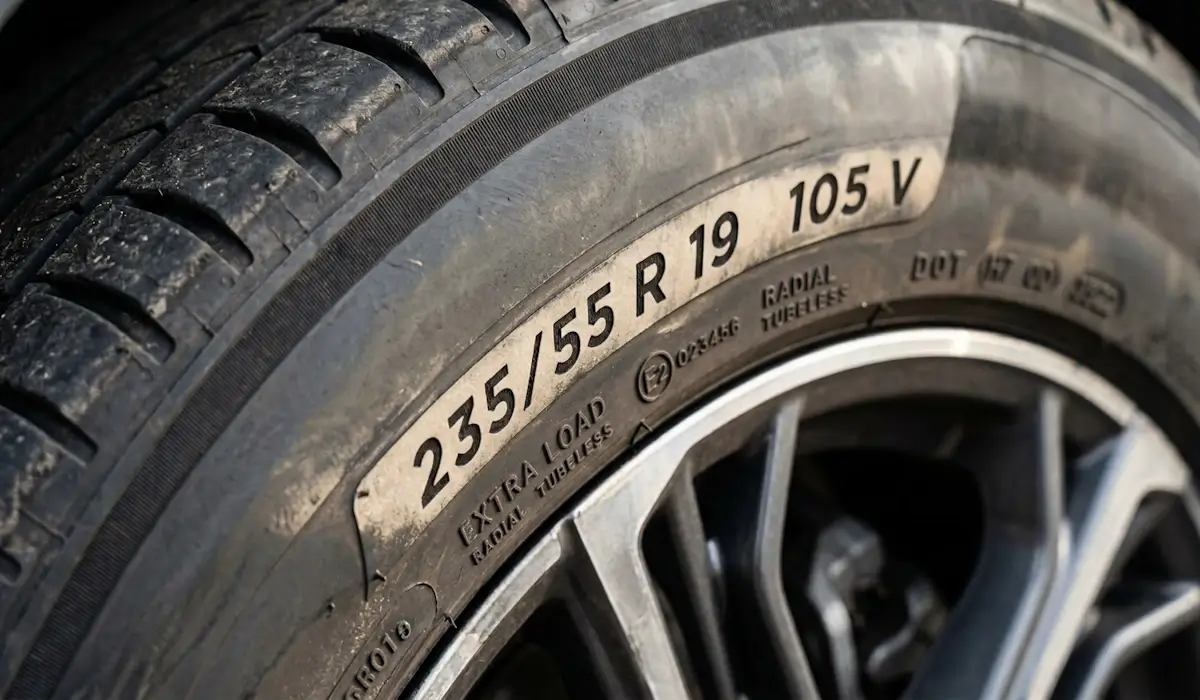
Ask ten caravanners what caravan tyre pressure they run and you’ll probably get ten different answers.
Someone told them “60 all round,” they copied the number off the placard years ago, or they
simply haven’t checked it against the load they’re actually carrying. Tyre pressure is one of
those things that sits quietly in the background until it doesn’t: a blowout on the highway,
uneven wear that chews through a set early, or a van that doesn’t feel right behind the tow
vehicle.
Here’s the part that’s easy to miss: the pressure your tyres need depends on the tyre, the load they’re carrying and the manufacturer’s specifications. Start with those figures, use
your actual loaded weight where appropriate, and you can arrive at a sensible cold starting
pressure rather than simply guessing. This is how to do it properly, cold, and how to check
you got it right.
Placard first – then refine it for your load
You’ll hear “always follow the placard,” and that’s sound advice. The important thing is
understanding what the manufacturer’s figure applies to. Your caravan’s compliance plate and
owner’s manual give the manufacturer’s specified tyre pressure for that vehicle and tyre
configuration. If the tyre manufacturer also provides a load/inflation table, that can help
determine the pressure appropriate to a particular load.
If you’re using a load-based calculation, don’t simply reduce the placard pressure because your
caravan happens to be lighter. First check the caravan manufacturer’s and tyre manufacturer’s
recommendations, then use your actual measured axle or wheel loads where a load-based pressure
is appropriate. Running substantially more pressure than the tyre needs for its actual load can
affect ride, handling and tread wear – but don’t drop below the manufacturer’s recommendation
just because the van is lightly loaded.
So this isn’t about ignoring the placard, it’s about using your actual load to arrive at a sensible figure within the manufacturer’s limits.
A few honest ground rules:
- Never exceed the tyre’s maximum cold pressure stamped on the sidewall, or your wheel and
axle limits. If you’re unsure, follow the caravan and tyre manufacturer’s specified pressure
until you can confirm the correct figure. - The manufacturer’s figures come first. Where your tyre maker publishes a load/inflation
table, use it in preference to any formula – a formula is an estimate, the table is the spec. - Only go lower if you’ve actually weighed the van. A load-based pressure is only as good
as the weight you feed it. Guess the weight low and you’ll under-inflate – which is
genuinely dangerous. Use a weighbridge or mobile weigh, not a hunch. - There’s a minimum. Matching pressure to load doesn’t mean simply running as little
pressure as possible. Stay within the pressure range specified by the caravan and tyre
manufacturers, and confirm with the 4 PSI rule further down. - If in doubt, ask a pro. A tyre retailer or the tyre manufacturer can confirm the right
pressure for your exact tyre and load.
Get those right and a load-based figure is a refinement of the placard, not a contradiction
of it.
Step 1: Work out the weight on the tyres
This is the part people get wrong, so it’s worth being precise. The weight that matters for
tyre pressure is only the weight sitting on the trailer’s own tyres – not the whole caravan.
When you’re hitched up, part of the caravan’s weight is carried by the tow ball on the car. So:
Weight supported by caravan tyres = actual loaded mass − tow ball weight
When the caravan is weighed in its towing configuration, the loaded caravan mass minus the
tow-ball mass gives the Gross Trailer Mass (GTM) – the mass carried by the caravan’s wheels
and axles.
(Note: ATM is the maximum allowable loaded mass, not necessarily what you’re towing today –
so use your weighed loaded mass, not the ATM off the plate, whenever you can.) If you’ve seen
other calculators ask for GTM while ours asks for loaded mass and ball weight, they’re the same
thing – we just subtract the ball weight so you can read both numbers straight off your
weighbridge ticket.
Best case: get the caravan weighed loaded and ready to travel. Most people underestimate
their caravan’s real weight, usually by a lot. A weighbridge or a mobile caravan weigh takes the
guesswork out of it.
No weighbridge yet? You can use the plate figures as a provisional reference, but don’t treat the ATM as your actual loaded weight. ATM is a maximum, not a measurement of what your caravan weighs today. For a load-based calculation, replace the estimate with your actual weighed loaded mass as soon as you can.
One more thing: a simple sum assumes the load is split evenly across the tyres. In reality one
side can carry more than the other depending on how you’ve packed. If you’re close to the
tyre, wheel or axle limits, get individual wheel or axle weights rather than relying on an
even-split figure.
Read your tyre’s two key ratings
Everything else you need is printed on the tyre sidewall, usually in small text near the
rim:
- Max Load – the most weight one tyre can carry, in kg (e.g. Max Load 670kg).
- Max Pressure – the maximum cold inflation pressure, in PSI or kPa (e.g. Max Press 60 PSI).
If it’s only in kPa, divide by about 6.9 to get PSI. Note that this is a maximum
spec, not automatically the pressure you should run.
Don’t know your tyre’s maximum load? Look for the load index in the tyre’s service
description – for example, the 94 in 205/65R15 94H. The load index corresponds to a maximum
load in kg: 94 = 670kg. The scale runs from about 60 (250kg) up past 125 (1650kg+), and it’s an
international standard, so it works the same on Australian and imported US tyres. If the sidewall
prints the max load directly, use that figure.
Never run beyond your rating. Keep the load on each tyre within its rated maximum, and
within your wheel and axle limits. If your sums say a tyre is carrying more than it’s rated
for, the fix isn’t more air – it’s less weight, or more tyre.
Step 3: Do the sum
A widely used method scales the tyre’s maximum pressure to the share of the load each tyre is
actually carrying:
Important: This is a linear estimate, not a universal tyre-pressure specification. Tyres
don’t necessarily have a perfectly linear load-to-pressure relationship. If the tyre
manufacturer provides a load/inflation table for your exact tyre, use that instead.Pressure = Max Pressure × (load per tyre ÷ Max Load)
Load per tyre is just the weight on the tyres divided by how many there are- 2 for a single axle, 4 for a tandem, 6 for a tri-axle.
Illustrative worked example
- Tyres:
205/65R15 94→ Max Load 670kg, Max Pressure 60 PSI - Actual loaded mass: 1,800kg, tow ball weight (TBM): 150kg
- Tandem axle → 4 tyres
Weight on tyres: 1,800 − 150 = 1,650kg
Load per tyre: 1,650 ÷ 4 = 412.5kg
Pressure: 60 × (412.5 ÷ 670) = ≈ 37 PSI cold
So this van sets to about 37 PSI as a starting figure — not the 60 on the sidewall and not
a blanket “guess.” Change the load, and the number changes with it — which is exactly the
point. Before you rely on it, cross-check against your tyre maker’s load/inflation information
and your caravan manufacturer’s requirements.
If doing this by hand isn’t your idea of a good time, our Tyre Pressure Calculator runs the
whole thing for you: punch in your weights and tyre ratings (kg or lbs) and it gives you a
cold starting pressure to check against your tyre maker’s figures.
Step 4: Set them cold – and know what “cold” means
Tyre pressure rises as the tyre warms up, so every figure above is a cold figure. “Cold”
doesn’t mean a chilly day – it means the tyre hasn’t been driven on (parked at least a
few hours, or first thing in the morning).
You can’t set a hot tyre to a cold target – the reading’s already inflated by the heat. So
check and adjust before you leave, not after an hour on the road. And don’t try to
“pre-empt” a hot day by dropping a few PSI; set the correct cold figure and let the tyre do
its thing.
Step 5: Confirm it with the 4 PSI rule
Here’s a handy real-world check, you can sanity-check your figure with just a pressure gauge.
It’s called the 4 PSI rule:
- Set the tyres to your calculated pressure while cold.
- Tow normally for 30 – 60 minutes.
- Check them again while they’re hot.
As a practical field check, a road tyre will often gain around 4 PSI from cold to hot under
normal bitumen driving conditions. What that tends to tell you:
- Rose about 4 PSI → in the right range. Leave it.
- Rose more than 4 PSI → the tyre may be working harder than expected. Check the cold
pressure and manufacturer’s recommendations before making an adjustment. - Rose less than 4 PSI → the tyre may be running more pressure than necessary for the
conditions. Check the manufacturer’s recommended pressure before making an adjustment.
For many light-truck (LT) tyres – common on heavier off-road vans – around 6 PSI is
commonly used as the reference point instead. Use 6 as your guide if that’s what you’re on.
Treat the 4 PSI rule as a field check, not a law. Not every tyre manufacturer endorses it, and
ambient temperature, speed and road all nudge the numbers. If a reading is well off, adjust
once the tyres are cold and re-check under similar conditions.
What tyre pressure should my caravan be?
There’s no single right answer – it depends on the weight sitting on the tyres, the tyres themselves and the manufacturer’s recommendations. Work out your loaded weight minus tow ball weight, divide by the number of tyres, and scale your tyre’s max pressure to that load as a starting point. In general, tyre pressure and load are related, but the correct pressure still depends on the tyre manufacturer’s specifications and the actual load. Set it cold, cross-check
the manufacturer’s info, and confirm with the 4 PSI rule.
Should I use ATM or GTM to calculate tyre pressure?
Use your actual weighed figures. GTM is the weight on the axles – your actual loaded mass minus the tow ball weight. ATM is the *maximum* allowable loaded mass, so it’s not the number to calculate from unless you’re actually loaded to it. If a calculator asks for GTM, use your weighed GTM; ours asks for loaded mass and ball weight and subtracts the ball weight to get the same figure.
Why not just use the pressure on the placard?
The tyre pressure on your caravan’s compliance plate is the manufacturer’s specified pressure for the vehicle and tyre configuration, so it shouldn’t be ignored simply because your caravan is travelling below its maximum mass. If your tyre manufacturer provides a load/inflation table, you can use your actual measured tyre or axle loads to determine the appropriate pressure for that specific tyre. A load-based calculation can also provide a useful starting estimate, but it should be checked against the manufacturer’s information. When there’s any conflict, follow the caravan and tyre manufacturer’s specifications.
What is the 4 PSI rule?
A no-maths check on your cold pressure. Set the tyres cold, tow for 30 – 60 minutes, then check them hot. A gain of about 4 PSI is commonly used as a field reference; a larger increase may indicate the tyre is working harder than expected, while a smaller increase may indicate more pressure than necessary for the conditions.
Check the manufacturer’s recommended pressure before making any adjustment. Light-truck (LT) tyres are sometimes assessed using around 6 PSI instead.
It’s a field check, not a manufacturer specification, and not all tyre makers recommend it.
How do I find my tyre’s max load if it’s not written out?
Look for the load index in the tyre’s service description (e.g. the 94 in 205/65R15 94H). It maps to a maximum load (94 = 670kg) on an international scale, so it works for Australian and imported tyres alike. Our calculator has a built-in load-index lookup if you’d rather not memorise the table.
Do I set tyre pressure hot or cold?
Always cold – meaning the tyres haven’t been driven on (parked a few hours, or first thing in the morning). Pressures rise with heat, so a hot reading is already inflated and can’t be set to a cold target.
Can I calculate pressure for US trailer tyres too?
Yes, but check the specific tyre manufacturer’s instructions. US trailer tyres can use different load/inflation recommendations, and some manufacturers specify operation at the tyre’s maximum cold pressure. Don’t assume the same calculation or pressure recommendation applies to every ST tyre. The load index is the same international scale, so enter weights in kg or lbs and treat the result as a starting estimate.
Conclusion
The right caravan tyre pressure isn’t a number you guess or borrow from a mate – it depends on
the load your tyres are actually carrying, within the limits set by your caravan and tyre manufacturers.
Start with the manufacturer’s figures, weigh the caravan in the condition you tow it, and work from
your real weight – actual loaded mass minus tow ball weight, which gives you the GTM – rather than
the maximum mass on the plate.
From there, the method is simple: use the load on each tyre to calculate a cold starting pressure,
keep everything within the tyre’s rated load and your wheel and axle limits, and set the pressure
cold. Then use the 4 PSI rule as a field check – not a specification – to see whether the result is in the expected range.
Remember, the calculation is a starting estimate. If your tyre manufacturer publishes a load/inflation table for your specific tyre, that takes priority. And when in doubt, a tyre professional can confirm the appropriate pressure for your exact tyre and load.
Get the weight right, use the right tyre information, and set the pressure correctly – and you can
stop relying on guesswork.
Ready to put it into practice?
Weigh the caravan, check the manufacturer’s information, and run the numbers with our Tyre Pressure Calculator.
Safe travels.